

Chapter 1: Propaganda on the Pitch
May 24, 1934, Rome. On the pitch of the Stadio del Partito Nazionale Fascista, the Mexican national team players move sluggishly in the spring heat, their legs pulling them toward the ground like lead. Pedro Gonzalez and Felipe Rosas gasp for air with every sprint; every minute of their weeks-long sea voyage, as well as the extra six kilos they gained during their inactivity, shows in their movements. Facing them is American player Aldo “Buff” Donelli—a college amateur American football coach in civilian life—who pushes forward unstoppably and fires into the net for the fourth time this afternoon. The referee blows his whistle three times. Mexico loses 4-2.
This clash was no meaningless friendly, but the final, decisive qualifier for the 1934 World Cup. Due to the logistics of the era and the difficulties of transoceanic travel, this do-or-die match had to be played on-site in Rome, barely three days before the tournament officially began. The Mexicans essentially treated the trip as a vacation. After gambling at a casino back home in Orizaba, they embarked on a grueling 15-day cruise via Havana, Bermuda, the Spanish coast—Vigo, La Coruña, Santander—and Southampton, before finally taking a train through Paris to Rome. In contrast, the Americans were much more purposeful: they made the journey on an Italian steamship in just nine days, arrived ten days before the match, and kept in shape by playing American football on deck. The Mexican delegation thus traveled for weeks, only to pack their bags immediately after a single defeat and begin another weeks-long voyage back home.
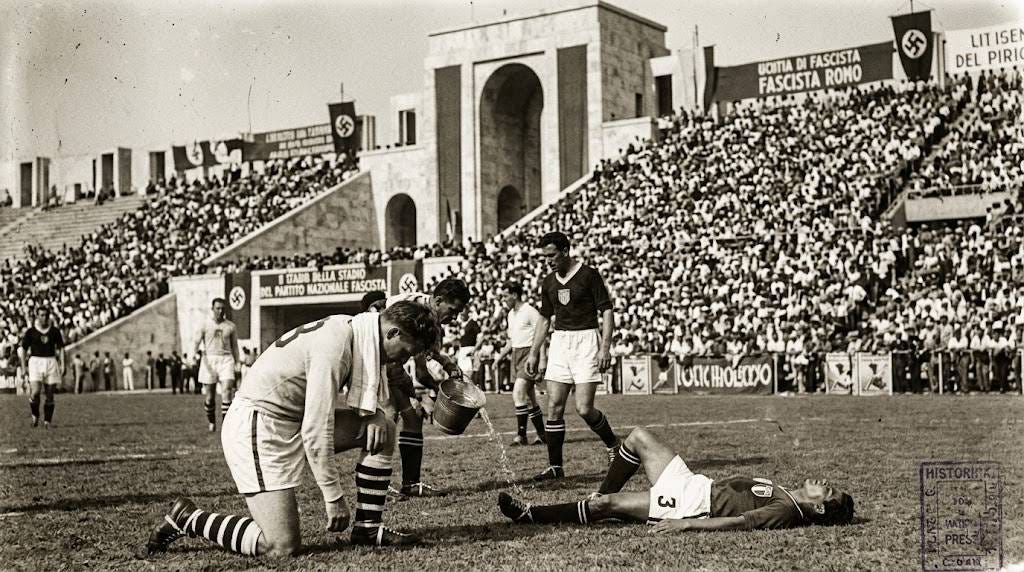
The Rome tournament, however, was depleted not only by the exhaustion and absurd qualifiers of those arriving from distant continents. Several of international football’s major powers deliberately stayed away. Defending champions Uruguay boycotted the competition, feeling insulted that four years earlier, the majority of European nations had refused to cross the ocean for the Montevideo tournament. To this day, they remain the only team in the sport’s history not to defend their World Cup title.
The British nations—England, Northern Ireland, Scotland, and Wales—similarly stayed away. They believed their own domestic tournament, the Home Nations Championship, was worth much more than the Rome tournament and was, in fact, the true world championship. Charles Edward Sutcliffe, a leading figure in the English FA, outright despised FIFA. He considered the organization’s “one country, one vote” principle to be democratic nonsense, serving only to “magnify the dwarfs”. The English found it outrageous that, as the inventors of the sport, they would have the same voting power as a nation with no footballing history. In their arrogance, they maintained their exclusive right to create and amend the laws of the game until 1958, ignoring the international governing body. The fascist Italian press seized the opportunity, twisting Benjamin Disraeli’s 19th-century foreign policy doctrine to mockingly refer to the British absence as “splendid isolation”. For Benito Mussolini, the incomplete field and the British absence were not a problem; in fact, they offered an unrepeatable historical opportunity. The Italian dictator accurately recognized the immense mass-psychological and communicative potential of football to demonstrate Italian superiority.
Italy had already won the hosting rights at the 1932 FIFA Congress—ironically held in Stockholm, the capital of their main rival, Sweden. This diplomatic victory was largely due to Giovanni Mauro, the secretary of the Italian Football Federation, who had been lobbying informally on behalf of his government since 1930. Mauro made an extraordinary guarantee to FIFA that settled everything. He promised that if hosting the World Cup resulted in a financial loss, the Italian state would cover the entire deficit. As this was during the hardest years of the Great Depression, such a risk-free offer was simply impossible for the international committee to refuse.
Achille Starace, the fascist regime’s propaganda guru and “High Priest of the Cult of the Duce,” took complete control of the tournament’s visual and ideological branding. Starace’s goal was to let fascist iconography infiltrate every corner of everyday life through the World Cup. Over 300,000 posters were printed, special stamps bearing World Cup images were issued, and an official cigarette brand named Campionato del Mondo (World Championship) was even launched in honor of the event. The regime unequivocally used the sporting event for the philosophical and ideological validation of national strength.
The football infrastructure was also consciously shaped in the image of power, prioritizing the monumentality of fascist architecture. In Turin—the city Mussolini was most connected to regarding football—the facility originally built for the 1933 International Youth Games was renamed Stadio Benito Mussolini (today’s Stadio Olimpico di Torino) in honor of the tournament. A similarly symbolic decision was made in Naples. A stadium built in honor of a local industrialist, Giorgio Ascarelli, previously known as Stadio Vesuvio, was renamed Stadio Partenopei for the duration of the championship. With this name choice, the regime emphasized glorious historical roots, referring to the Parthenopeans, the ancient Greek mythological founders of Naples. Later, during World War II, this Neapolitan stadium was completely destroyed by Allied bombings, and today residential buildings stand in its place.
Meanwhile, Mussolini masterfully played the role of the “man of the people”. At the opening match, in a spectacular theatrical display, he stood in line at the ticket booth to buy his own ticket for the “People’s Cup” before taking his seat in the VIP box (tribuna d’onore) alongside the royal family and foreign diplomats. The dictator played a double game: he wanted to strengthen party loyalty among the domestic audience, while showing foreign guests and journalists the image of a perfectly organized, modern, and happy nation. Since 1934 was the first World Cup where foreign fans could travel in large numbers—ten thousand Swiss and twelve thousand Austrians arrived—it was a matter of prestige for Mussolini that the matches starting simultaneously in eight different Italian cities ran smoothly and like clockwork.
The reality, however, sometimes cracked under the weight of propaganda. One of the tournament’s most embarrassing problems was the lower-than-expected attendance at non-final matches. While the 1930 Uruguayan World Cup was held in a single city, Italy’s eight venues—including Bologna, Florence, Genoa, and Trieste—spread the fans too thin. The regime, however, found a solution using the newly mass-adopted medium of radio. Although Italian radio broadcasts constantly blared that the stadiums were packed to the rafters with workers celebrating their heroes, the reality was that significant empty patches often yawned in the stands.
The sets were in place, the propaganda machine was roaring, but there remained one variable that could not be controlled by decrees: the football itself. The crushing weight of victory and the regime’s legitimacy thus fell onto the shoulders of one man: national team manager Vittorio Pozzo. Without the option of failure, Pozzo had to forge his players into an uncompromising army.
Chapter 2: Soldiers in Football Boots
Spring 1934, a dimly lit Roman pub. The man leaning over the billiard table, Attilio Ferraris, hasn’t played a single minute for the Italian national team in the past eighteen months. In March, his own club, AS Roma, fired him due to indiscipline, worsening alcoholism, and a gambling addiction. The pub door suddenly opens, and Vittorio Pozzo, the manager of the national team, appears on the threshold. He walks up to the debauched midfielder and states in a tone that brooks no contradiction: “Drop the cigarette, the drinks, and the billiard cue immediately, come with me, and you’ll have a chance to play in the World Cup”. Ferraris, though drunk at the time, puts down the cue and follows the manager. A few weeks later, at the training camp on the shores of Lake Maggiore, Ferraris shows up in the best physical condition of all the players.
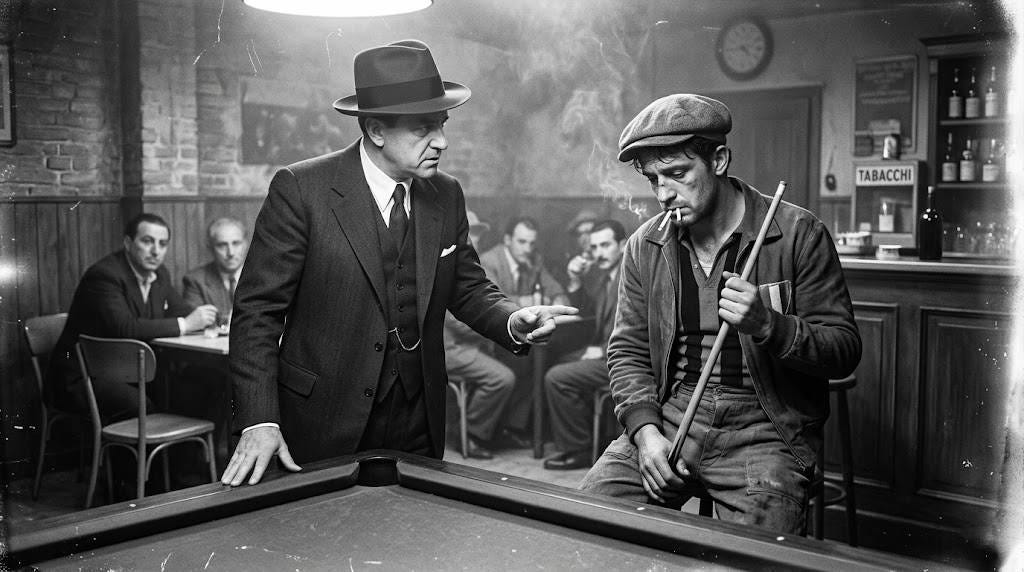
Although the scene seems almost too cinematic, it was Vittorio Pozzo himself who spread the story in the Italian press. Pozzo was not just a football coach; he was also one of the most influential sports journalists of the era, actively working for the Turin daily La Stampa. Pozzo perfectly understood narrative building. He consciously used the media to craft his own image as the commanding “Stern Old Master”. He continued publishing constantly even during the World Cup. He analyzed his own team’s matches in the newspaper, consistently referring to himself in the third person to appear as an independent, objective journalist. He needed the Ferraris anecdote to demonstrate his unquestionable, disciplinarian power to the public—and to his players.
This authoritarian leadership style stemmed from Pozzo’s past. During World War I, he served as an officer in the elite mountain infantry unit, the Alpini. His military background deeply defined his coaching philosophy; he frequently used war metaphors and treated the football pitch as a battlefield. He was convinced that success could only be achieved through extreme sacrifices and Spartan discipline. In this spirit, he isolated the national team from the outside world for weeks before the tournament. He held a 40-day, ascetic training camp, first in the Western Alps, and later in the idyllic but strictly guarded tranquility of Roveta in Tuscany.
Instilling discipline, however, was a much easier task than smoothing over internal conflicts within the team. The squad’s two most important players—the rock-solid Argentine-born midfielder Luis Monti of Juventus, and Bologna’s brilliant striker Angelo Schiavio—hated each other implacably. The press and the public were certain the two stars couldn’t work together, meaning Pozzo would have to choose between them, as there wasn’t room for both in one squad. The manager’s move, however, shocked everyone. Not only did he call both of them up to the national team, but when the squad arrived at the mountain training camp, he informed them that for the next two months, the two of them would share a room.
Pozzo’s pedagogy worked. The confinement and the complete exclusion of the outside world forged a team spirit and camaraderie within the Italian squad the likes of which had never been seen before. Pozzo paired this mentality with a highly disciplined tactical system known as the metodo. While most contemporary teams played in a more open, attacking formation, Pozzo emphasized defense and lightning-fast counterattacks. The essence of the metodo was to drop two players deeper from the midfield, thereby strengthening the defense, while instructing the attackers to launch quick counters. This formation was physically extremely demanding, but the Italian team, prepared with military rigor, was trained exactly for this. Pozzo’s army was ready for battle.
Vittorio Pozzo’s military past manifested not only in the Spartan discipline forced upon his players but also in his match evaluations. In the June 1 issue of La Stampa, he reported on the quarter-final against the Spanish national team with the voice of a frontline correspondent: “It was the most furious battle ever seen in the international arena, a merciless struggle, a fight to the death between the two most typically Latin teams”. However, after the open-visor clash that ended in a 1-1 draw, there was no stopping. Since penalty shootouts had not yet been invented, tournament rules dictated that the physically and mentally destroyed teams had to take the pitch again the very next day, June 1, for a decisive replay.
For the next day’s match, the Spaniards were forced to do without the injured Zamora and deploy their backup goalkeeper. Italy eventually won another rock-hard encounter 1-0, but the suspicion of intimidation and referee bias hung in the air throughout. The Iberians accused both Belgian referee Baert and Swiss referee Mercet of being noticeably lenient toward the home team’s physical aggression. Ricardo Zamora noted bitterly years later that this matchup should actually have been the final, because in this tournament, these two were the best teams in the field.
The lines of the football pitch, however, were redrawn by Italy’s political interests, and the machinations were not limited to the home team’s matches. The fascist machine fine-tuned the outcome on the other side of the bracket as well. The semi-final between Germany and Czechoslovakia was refereed by an experienced Italian official loyal to the regime, Rinaldo Barlassina. Barlassina consciously managed the match to ensure the Czechoslovak team, considered weaker and less of a threat, advanced, thereby guaranteeing that Italy—should they reach the final—would face a tired and easier opponent.
After the “bloodbath” in Florence, dead silence reigned in the Italian dressing room. Covered in wounds, the players slumped onto the benches in exhaustion, but Pozzo knew the most brutal test was yet to come. In Milan, in the World Cup semi-final, the Austrian Wunderteam, unbeaten in 14 matches, and the era’s greatest genius, Matthias Sindelar, awaited them. The stakes were terrifying; defeat would mean the collapse of the grandiose propaganda—and Mussolini’s ruthless wrath. Pozzo then approached the most brutal man on his team, Luis Monti. The order was clear. In Milan, at any cost, he had to physically neutralize the “Paper Man”.
Chapter 3: The Fall of the Paper Man
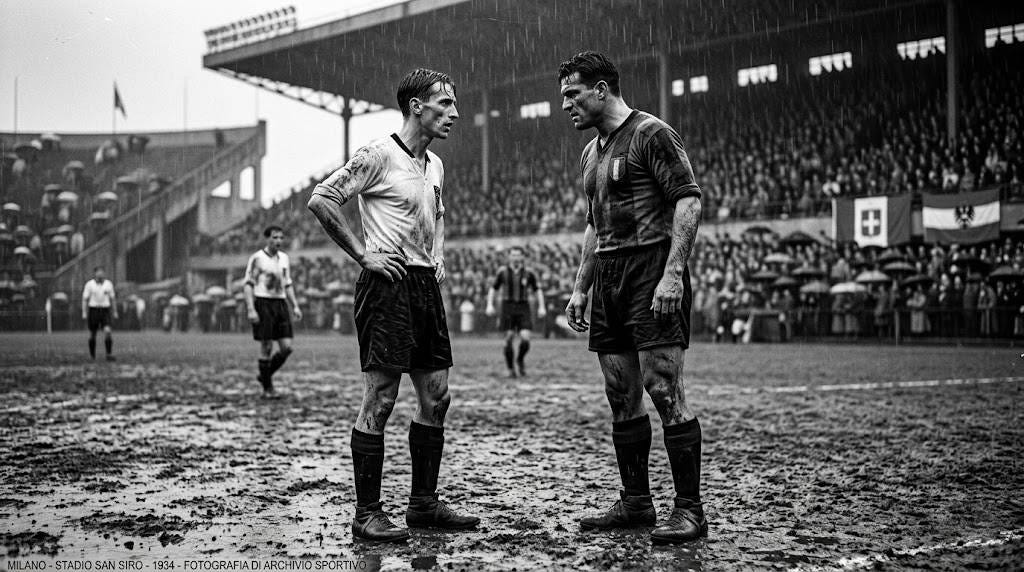
June 3, Milan. A noticeably thin, almost fragile figure emerges from the player tunnel onto the soaked turf of the San Siro. In the stands, 35,000 people murmur, including an astonishing number of 12,000 Austrian fans who crossed the border just to see their idol. The body of Matthias Sindelar, the Austrian star, is covered in bruises after a rock-hard quarter-final against the Hungarians, but he insisted on playing even while injured. As he looks up, his gaze immediately meets that of the Italian center-half, Luis Monti. The tension in the air is palpable. Pure footballing artistry and uncompromising brute force stare each other down in the Milanese rain.
This semi-final went far beyond a simple sports match. It was a historic clash of two completely opposing football philosophies. The Austrian national team, the legendary Wunderteam (Wonder Team), arrived in Italy as the overwhelming tournament favorites. The team managed by Hugo Meisl represented a wholly unique, innovative style: the Central European “Danubian School”. The roots of this tactic reached back to an English pioneer, Jimmy Hogan, who, as Meisl’s mentor, convinced the manager to build the team’s play around the fragile Sindelar’s genius rather than physical strength.
Hugo’s brother, the renowned journalist Willy Meisl, described this football as placing pure intellect above muscle power. The players performed with incredible virtuosity, precision work, and an inexhaustible repertoire of ideas. This elegant, short-passing system demanded exactly the kind of intellectual, mental superiority on the pitch that was embodied in the world of chess matches and heated debates at Viennese coffeehouse tables. The players, moving almost telepathically on the same wavelength, consistently bewildered opponents who reacted even a fraction of a second slower than them.
With this mesmerizing game, the Austrians conducted a veritable campaign of annihilation in Europe. During their 14-match unbeaten streak, they destroyed Scotland (5-0), Switzerland (8-1), Germany (5-0 and 6-0), and inflicted an 8-2 defeat on the Hungarians. The Italians had particular reason to fear them, as in the preceding months, Vittorio Pozzo’s team had been beaten 4-0 in Genoa and 4-2 in Turin.
The brains of the machine was Matthias Sindelar himself. Referred to as the “Mozart of Football” or, due to his physique, the “Paper Man,” the genius was the era’s first true global star, whose face advertised Swiss watches, Italian suits, and Austrian cheeses. The legendary referee John Langenus flat-out stated that Sindelar’s goals were elegant masterpieces that no one else could have replicated. Although his own coach, Hugo Meisl, sidelined him for a long time in the 1920s, claiming the player merely had “the physique of a child,” his footballing intelligence ultimately compensated for any physical disadvantage.
The road to the Milan semi-final, however, demanded sacrifices from the team. In the hard-fought quarter-final against the Hungarians, they lost one of their most important attackers. Johann Horvath suffered such a severe injury that he was unable to take the pitch at the San Siro.
Vittorio Pozzo knew exactly that if the Wunderteam machine and Sindelar were allowed to unfold, the Italian World Cup dream would end. That is why he entrusted the task to his most ruthless man, Luis Monti, who was known as one of the most brutal enforcers of the era. The order was simple. He had to shadow the Paper Man and use his physical strength to nip every Austrian attack in the bud. The referee blew his whistle, and the militaristic Italian system swung into ruthless motion against the Viennese football artists.
The battle fought in the Milan mud brought not the triumph of Viennese finesse, but of Italian physicality. No matter how hard the “Paper Man” tried, Luis Monti, one of the most ruthless players of the era, followed him like a shadow and ground the genius down using the rawest of methods. The Austrians applied incredible pressure on the home goal. Statistics show they fired 22 shots on goal during the match, but veteran goalkeeper Gianpiero Combi, reactivated from retirement at Vittorio Pozzo’s request, proved to be an impenetrable wall that day.
The match was ultimately decided by a single, highly controversial goal. A strike by Enrique Guaita, an Argentine-born forward now playing in Italian colors, finally sealed the fate of the Viennese football artists. Italy won 1-0, eliminating the favored Wunderteam, and advanced to the final in Rome, where the surprise team, Czechoslovakia, awaited them.
The fascist machine was on the home stretch; the dreamed-of historic victory was only ninety minutes away. But in the hours before the June 10 final, tactical meetings were replaced by pure terror. Before the Italian team ran onto the pitch against the Czechoslovaks, a messenger entered the dressing room with a personal message from Benito Mussolini. The letter was chillingly clear. There would be severe consequences if the team did not win the trophy.
Luis Monti, the rock-hard midfielder, faced his fate pale-faced. Four years earlier, at halftime of the 1930 World Cup final in Uruguay—then as a member of the Argentine national team—he had already experienced a death threat. Back then, armed men sent word that they would kill his family if his team dared to win. Now, in Italy, the equation was reversed: they wanted to hurt him if he lost.
The players’ stomachs knotted as they walked from the dark tunnel onto the sunny turf of Rome’s Stadio del Partito Nazionale Fascista. Mussolini sat in the VIP box, the 55,000-strong crowd roared, and the whistle rose to the referee’s lips.
Chapter 4: Victory by Command
June 10, Rome. On the pitch of the Stadio del Partito Nazionale Fascista, a struggle for pure survival began. Suffocating, 32-degree Celsius heat ruled the pitch, taking a particular toll on the Czechoslovak national team players—including captain and goalkeeper František Plánička and the tournament’s top scorer, Oldřich Nejedlý. They had to contend with appalling conditions even before the opening whistle. The away dressing room’s facilities didn’t even reach the standard of a rural amateur club; there wasn’t even a shower, giving them no chance to refresh themselves in the scorching heat. With this exhaustion behind them, they had to face the hostile roars of the 55,000 fanatic spectators awaiting them.
In the VIP box stands Benito Mussolini in a military uniform, accompanied by high-ranking Nazi officials. The political stakes of the match had skyrocketed in the preceding hours. On the very day of the final, Czechoslovakia made its alliance with the Soviet Union official, provoking massive outrage from the Duce. For the fascist regime, the encounter instantly became the symbolic arena of a global ideological war between communism and fascism. The two teams line up on the pitch, and the Italians salute their leader with a fascist salute. Vittorio Pozzo’s players know exactly what is at stake for them beyond mere sport.
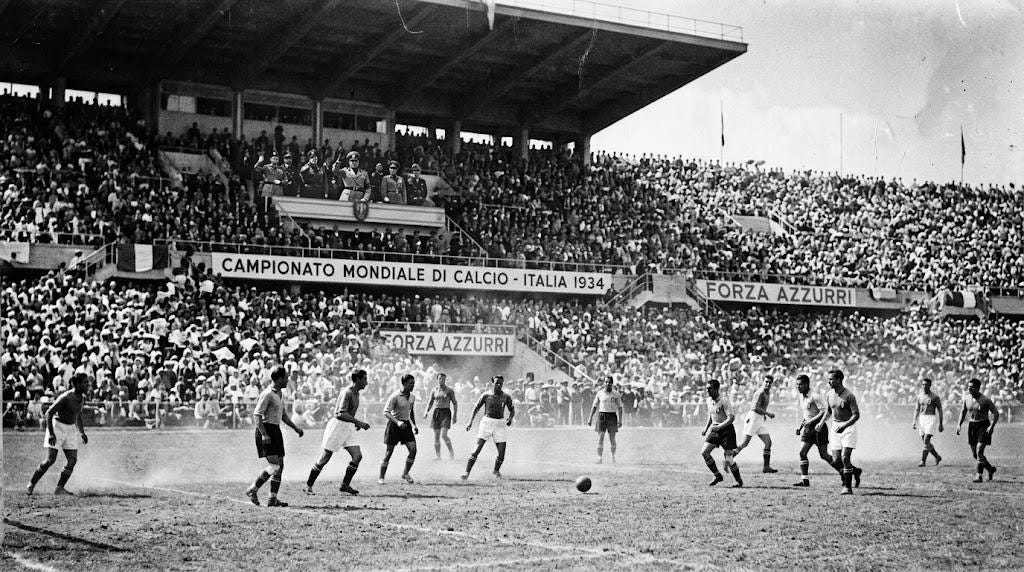
The Swedish referee officiating the match, Ivan Eklind, had already become the center of attention before the opening whistle. Prior to the match, Eklind was personally invited to Mussolini’s private box for a brief conversation. Although no official record was ever made of what was said there, what happened on the pitch quickly made the Swedish referee’s role clear.
From the beginning of the match, Eklind noticeably turned a blind eye to the Italians’ ruthless tackles. A key Czechoslovak player, Slavia Prague midfielder Rudolf Krčil, suffered a severe injury early in the match following an unpunished Italian foul. Since contemporary rules did not allow substitutions, Krčil had to fight through the match limping and in pain. Despite the one-sided refereeing and constant physical pressure, the Czechoslovak defense held firm. In the Roman heat, no goals were scored in the first seventy minutes of the clash. As time passed, the tension of the home crowd and the dictator waiting in the VIP box became increasingly palpable.
Despite the suffocating heat and constant physical pressure, the Czechoslovak defense held out, and the score remained goalless until the seventieth minute. Then, in the 71st minute, what all of Italy dreaded came to pass. Czechoslovak winger Antonín Puč scored in the Italian goal. The 55,000 spectators in the Roman stadium fell silent. In the VIP box, Benito Mussolini’s face froze. Vittorio Pozzo’s players were suddenly confronted with the full weight of the dictator’s pre-match threat. They had barely twenty minutes left to save their lives.
Desperation mobilized unprecedented energy in the home team. In the 81st minute, following an uncalled Czechoslovak foul, Argentine-born Italian attacker Raimundo Orsi equalized, forcing extra time. The physically and mentally exhausted Czechoslovak national team—who had practically fought the entire match with ten men due to Rudolf Krčil’s early injury—could no longer withstand the pressure in extra time. In the 95th minute, Angelo Schiavio, the Bologna striker—whom Pozzo had locked in a room months earlier at the training camp with his greatest enemy, Luis Monti—scored the winning goal that meant the World Cup title.
After the final whistle, the stadium erupted. The fascist anthem, Giovinezza, blared from the loudspeakers, while on the pitch the players turned toward the stands and saluted the leader. Alongside the official Jules Rimet trophy, the Italian national team also received the “Coppa del Duce,” commissioned by Mussolini, which was six times larger than the original.
Chapter 5: The Dark Price of the Trophy
With the victory in Rome, the fascist machine achieved its goal without reservation. The 1934 tournament became a historical milestone. It was the first time in the world that a state power explicitly used football for the global propaganda of its own ideology. Radio broadcasts transmitted in multiple languages, modernized stadiums, ubiquitous fascist symbols, and discounted train tickets all proclaimed the regime’s greatness to foreigners. This summer, football definitively lost its innocence.
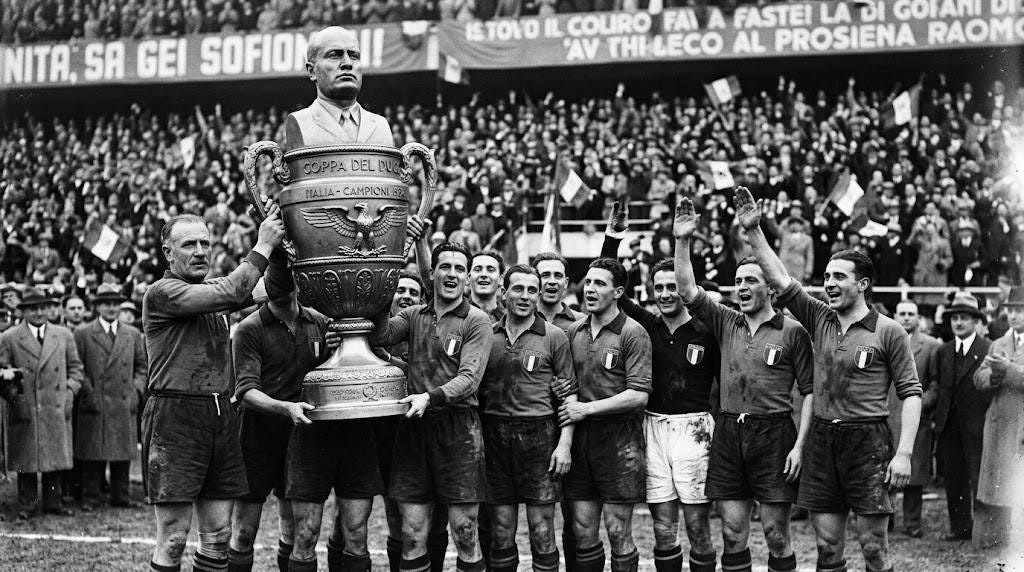
The fates of the final’s protagonists took peculiar turns. The Czechoslovak national team may have lost the final, but they were not treated as losers at home. A crowd of a hundred thousand waited and celebrated the returning team at Wenceslas Square in Prague, and the nation took them to its heart as the “Golden Boys”. In Italy, Vittorio Pozzo’s power became unquestionable. Four years later, in 1938, he defended the World Cup title—the only national team manager in football history to have achieved this—yet, in a strange twist of fate, the celebrated hero of the fascist regime was active in the Italian anti-fascist resistance from the autumn of 1943.
The players fulfilled their duty and survived the tournament, and the dictator received the much-desired international legitimacy.